Interactive Installation · HCI · Unity/Studio prototype · 2025
Presence Field: a body-reactive projection installation
A wall-scale particle field driven by a depth camera, where bodies displace and attract points and lines and several people create interference patterns.
- Client
- Self-initiated studio R&D
- Role
- Concept, Interaction design, Unity development, Sensing and calibration
- Year
- 2025
- Status
- Studio prototype
At a glance
- Problem
- Body-reactive installations are easy to demo and hard to run: latency, drifting calibration, fragile multi-person tracking and nobody to restart the machine.
- Context
- A self-initiated studio prototype built and run on a wall a few metres wide, ahead of any public commission.
- Concept
- A quiet field of points and lines that bodies disturb, hands attract and several people make interfere, falling silent when the room is empty.
- Experience
- Walk up and the field parts; raise an open hand and it gathers; move with someone else and the fields collide.
- Technology
- Depth camera and body tracking feeding Unity over OSC, TouchDesigner for signal routing and calibration, projection mapping and a watchdog for unattended operation.
- Role
- Concept, interaction design, Unity development, sensing and calibration, all in-house.
- Outcome
- Demonstrated an immediate, legible body-reactive field at studio scale with repeatable calibration and automatic recovery; scaling to a large wall remains open.
Technology stack
Related services
Overview
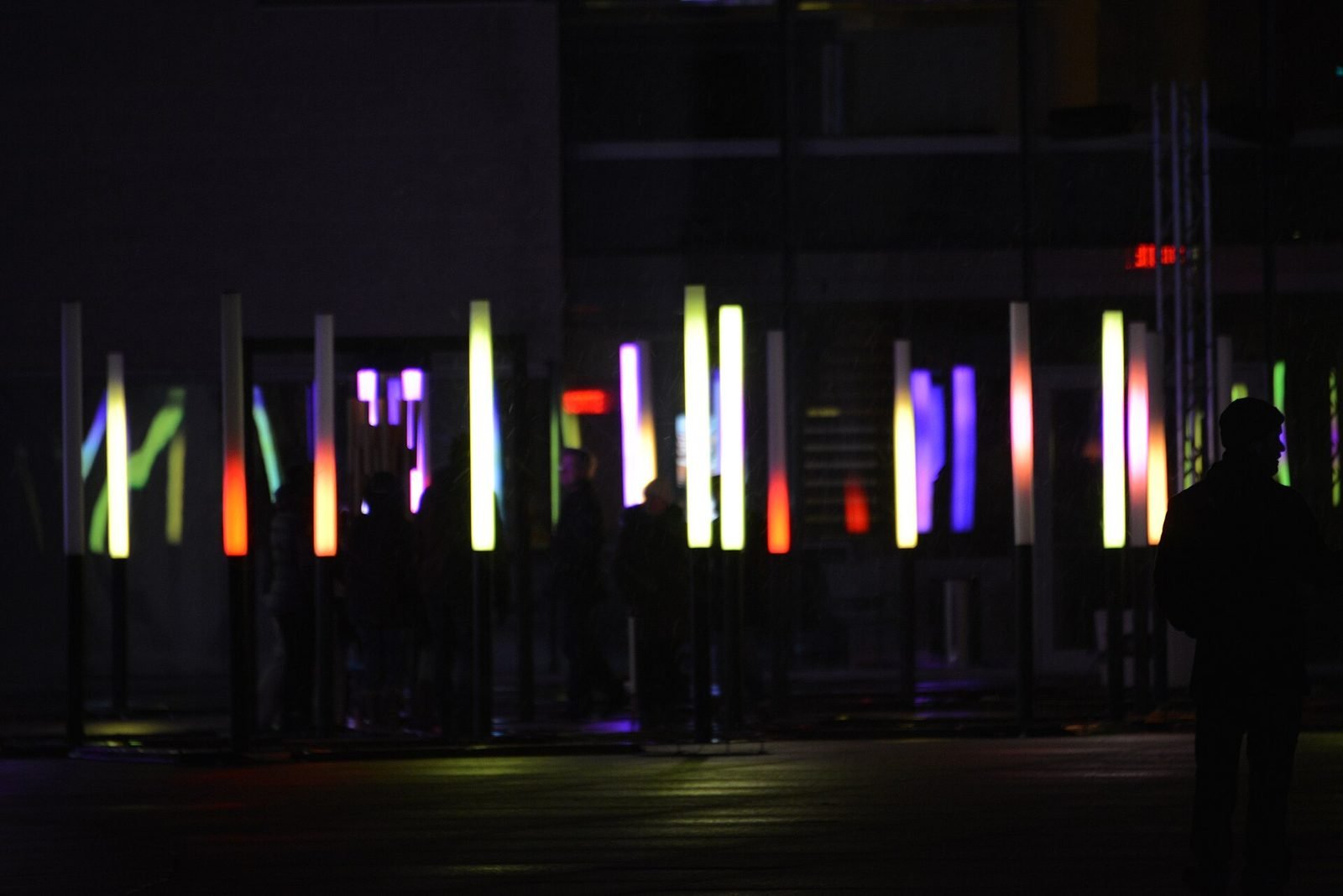
Presence Field is a self-initiated installation prototype: a wall-scale field of points and lines, projected onto a surface, that responds to the bodies in front of it. A depth camera tracks people; their silhouettes displace the field and their hands attract it. Two or more people produce interference patterns where their influence overlaps. When the room is empty, the wall goes still and silent. We built and ran it at studio scale, on a wall a few metres wide, to work out the sensing, calibration and operational questions before a public commission. It is the reference project for our interactive installations service.
Challenge
Body-reactive installations are easy to demo and hard to run. The usual failures are latency that makes the response feel disconnected from the body, calibration that drifts between projector and camera, tracking that falls apart with several people, and a machine that nobody restarts when it crashes on day three. The challenge was to make a piece that feels immediate with one person, stays coherent with five, and runs unattended from a morning power-on to an evening shutdown.
Research
We began by setting a latency budget. From published HCI work and our own tests, a response more than about 100 milliseconds behind the body starts to read as a follow rather than a reflection, so we measured every stage of the pipeline: camera exposure, skeleton estimation, network hop, simulation, render and projector input lag. We also studied how people behave in front of reactive walls, mostly by watching ourselves and visitors to the studio: the first move is almost always a wave, then a step forward, then a test of whether a second person changes anything. The piece needed to answer all three within seconds. Our guide to building an interactive installation sets out the general approach.
Concept
The field is a quiet material that bodies disturb. Points and short lines drift slowly on their own. A person's silhouette pushes them away, like a hand through still water; open hands pull them in. Two people's fields meet and form ridges and voids where they interfere. Nobody controls anything; the wall simply reacts in a way that is legible and consistent, so that people learn it by moving. Silence when the room is empty is part of the concept: the piece should not perform for no one.
Design
Interaction design decisions were tested with real bodies rather than mock-ups. Displacement follows the whole silhouette, not just the skeleton joints, so that clothing and props count. Attraction is tied to open hands held still, which gives a deliberate gesture a distinct result. Strength falls off with distance from the wall so people are drawn closer. Sound is a low texture that rises with total motion and drops to nothing after a few seconds of stillness. We avoided colour cues and text so that the piece reads across ages and languages. These are interaction design choices before they are technical ones.
Technology
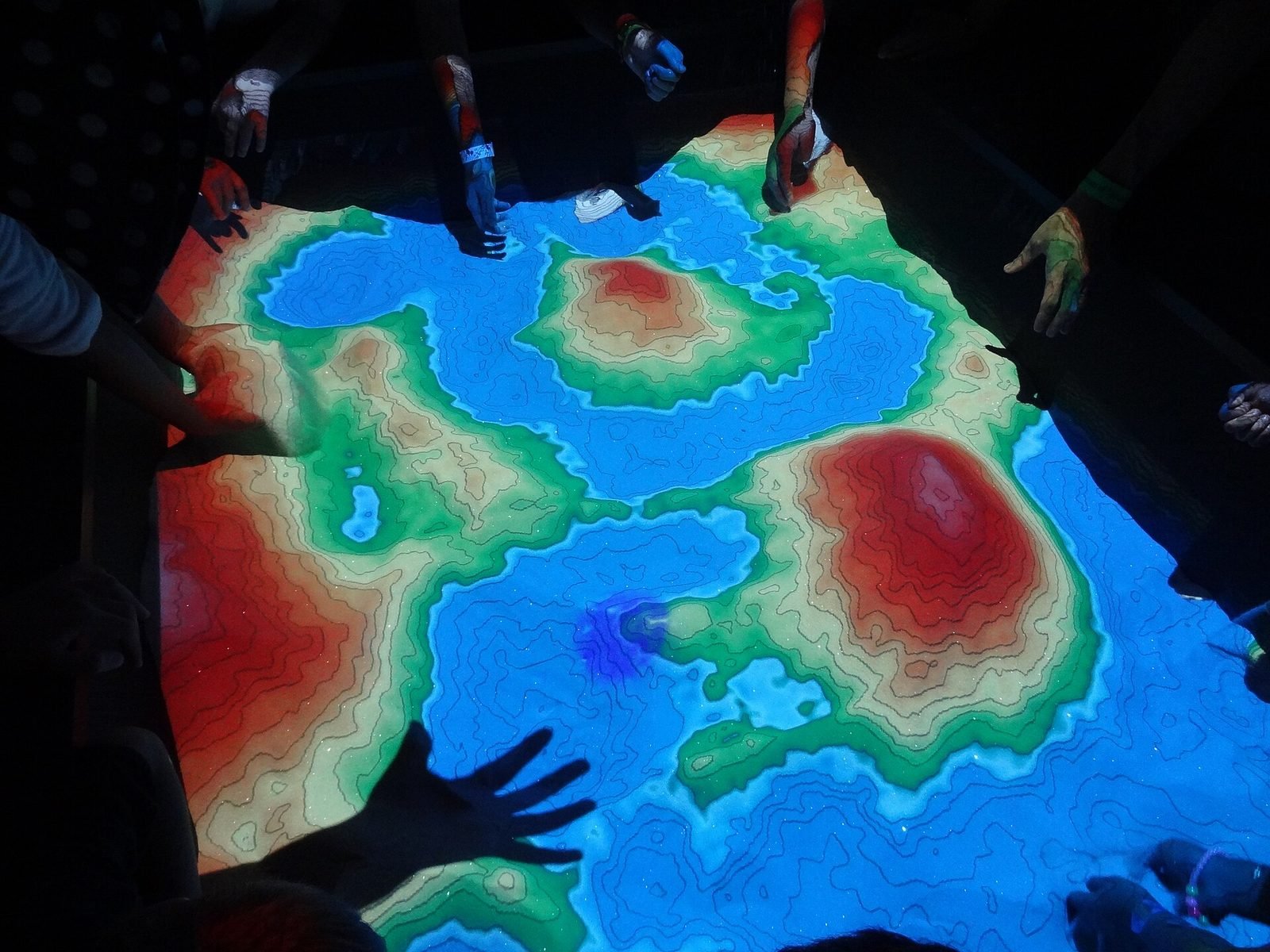
Sensing uses a depth camera mounted above the projector. Body and hand tracking run on a small machine next to the camera, which sends joint and silhouette data over OSC to the Unity application that simulates and renders the field. TouchDesigner sits between them for signal routing, smoothing and the calibration overlay. The Unity side is C# with a GPU particle simulation, and projection mapping handles keystone and lens correction. A separate watchdog process monitors heartbeats from both applications.
Interaction
There is nothing to learn. Walk up, and the field parts. Raise an open hand and the points gather. Move with someone else and the fields collide. Stand still, and the field settles around you. Leave, and the wall goes still. The piece is designed to be understood within a few seconds and to keep rewarding attention for a few minutes.
Implementation
Calibration maps camera space to projector space using a checkerboard shown on the wall and detected by the depth camera's colour stream; we store the transform and check it at boot against a reference. The measured end-to-end latency at studio scale sits within our budget after we moved smoothing from the tracking machine into the Unity side and dropped one network hop. For unattended operation the machine boots straight into the application, the watchdog restarts either process if heartbeats stop, and a scheduled task shuts the system down in the evening and brings it back in the morning. Logs are written locally and summarised once a day.
Result
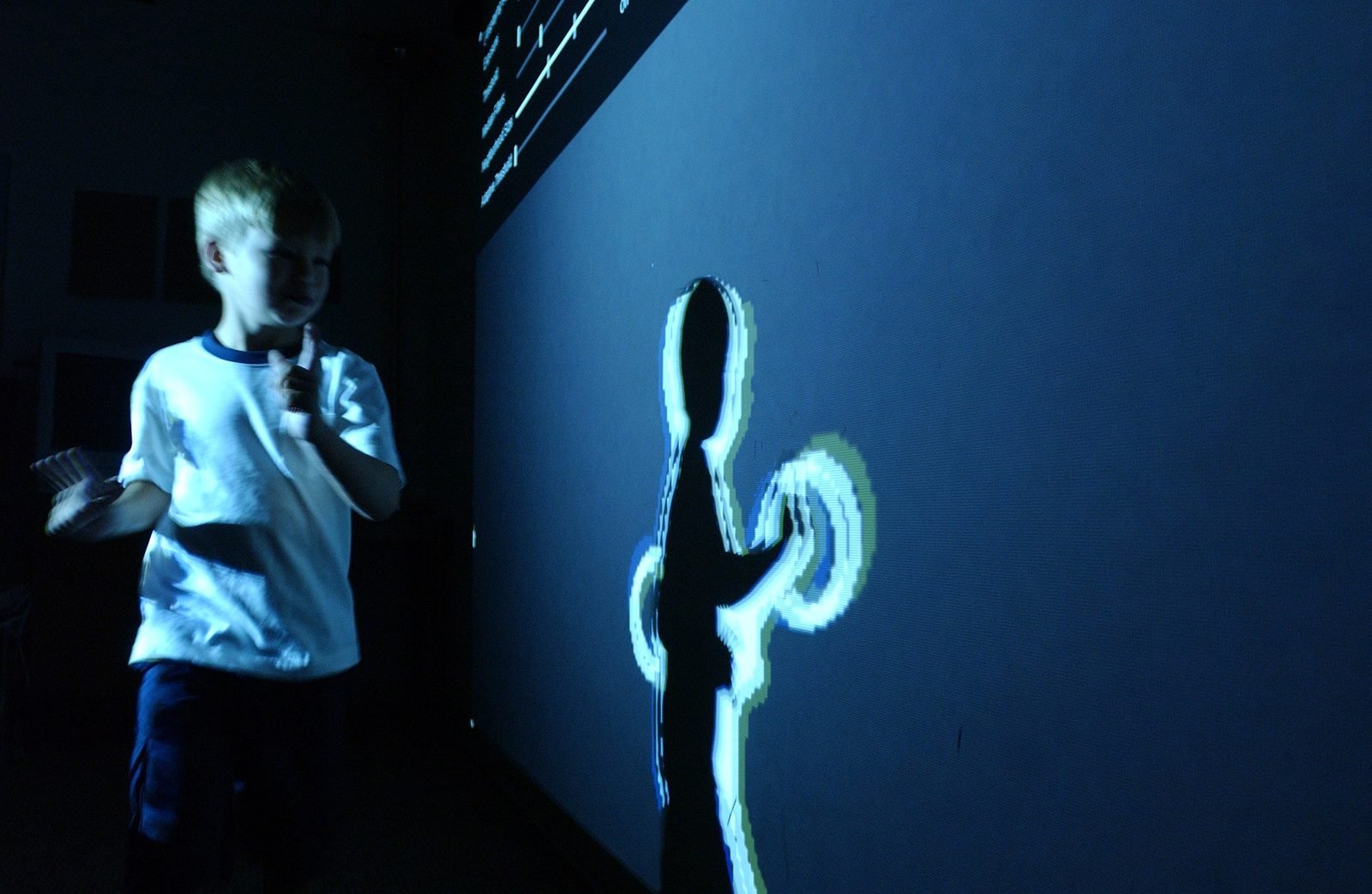
The prototype demonstrated a legible, immediate body-reactive field at studio scale, coherent with up to a handful of people in the camera's view, with calibration that survives a power cycle and a watchdog that recovers from application crashes without a person present. What remains open is scale: a wall of ten metres or more needs multiple cameras and projectors, with the stitching and synchronisation problems that brings, and public testing with crowds rather than colleagues. We have not yet installed the piece outside the studio.
Lessons
Measure latency per stage, not end to end; the slow stage is rarely the one you expect. Calibration must be repeatable by someone who did not build the piece. Tracking several bodies is more fragile than tracking one, so the visual language must degrade gracefully when a skeleton is lost. Unattended operation is a feature to design, not a configuration to set. And silence when empty is both an aesthetic and an operational choice: it saves the projector and tells staff at a glance that the system is alive but idle. If you are planning a reactive installation grounded in human-computer interaction, get in touch and we will share what we measured.
Further reading
How to build an interactive installation
A practical guide to interactive installations: concept, sensing, software, hardware, calibration, robustness when unattended, and what drives cost.
What is Human-Computer Interaction (HCI)?
Human-Computer Interaction is the study and design of how people use computing systems. What it covers, how it differs from UX, and why it matters for XR.